


Discover how Common Rail changed the role of the RT-flex camshaft.
.png)

%201.svg)

Why Does the Wärtsilä RT-flex Engine Still Have a Camshaft?
Electronic control systems have completely changed the design of modern low-speed marine diesel engines. One of the most common questions asked by marine engineers preparing for interviews and exams is:
If the Wärtsilä RT-flex engine uses a Common Rail system and electronic control, why does it still have a camshaft?
At first glance, this seems contradictory. However, the answer lies in understanding the role of the Common Rail Supply Unit.
From Mechanical Control to Electronic Control
Traditional two-stroke engines such as the MAN B&W MC and MC-C rely on a mechanical camshaft to perform several critical tasks:
- drive the fuel pumps;
- operate the exhaust valves;
- synchronize engine timing.
Because every event is mechanically linked to the crankshaft, the timing cannot be adjusted independently for each cylinder.
The introduction of electronically controlled engines changed this philosophy completely.
How Does the RT-flex Engine Work?
The Wärtsilä RT-flex engine replaces mechanical timing with the WECS (Wärtsilä Engine Control System) and the Common Rail system.
Instead of the camshaft controlling injection and exhaust timing:
- ICU units control the fuel injection valves.
- VCU units control the hydraulic exhaust valve actuators.
- WECS continuously calculates the optimal timing for every cylinder.
This allows precise control over combustion, lower fuel consumption, improved engine response and reduced emissions.
Why Is the Camshaft Still Needed?
Although injection and valve timing are now electronic, the engine still requires a reliable source of hydraulic and fuel pressure.
The remaining camshaft has only one purpose:
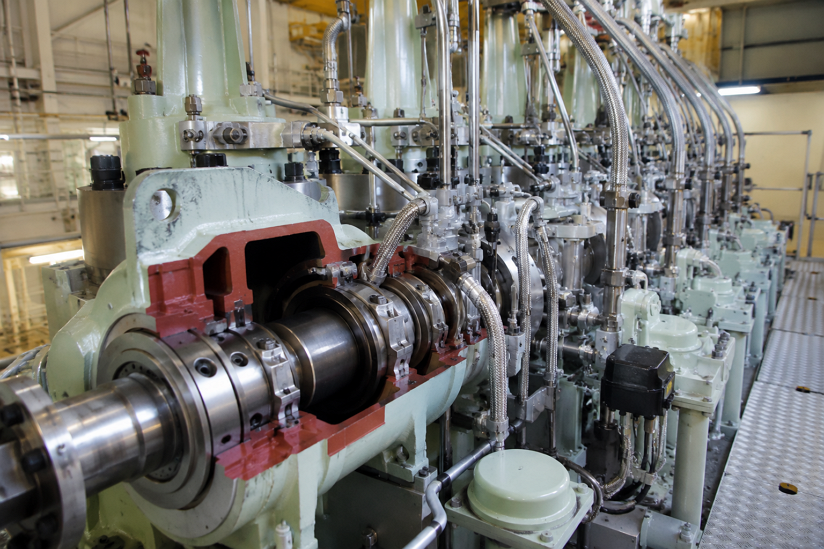
to mechanically drive the Supply Unit pumps of the Common Rail system.
These pumps maintain the fuel and servo oil pressure required for engine starting, low-load operation and normal engine running.
Without the Supply Unit pumps, the electronic control system would not have the hydraulic energy needed to operate the engine.
Comparison of Modern Two-Stroke Engines
EngineCamshaft FunctionMAN B&W MC / MC-CFuel pumps + exhaust valvesMAN B&W ME-CNo camshaftMAN B&W ME-BLight camshaft for exhaust valve hydraulic systemWärtsilä RT-flexDrives only the Common Rail Supply Unit pumps
Key Takeaway
The RT-flex camshaft no longer controls fuel injection or exhaust valves.
Its only function is to drive the Supply Unit pumps, ensuring that the Common Rail system always has sufficient fuel and servo oil pressure.
Test Your Knowledge
Want to learn more about Wärtsilä RT-flex engines and electronic engine control systems?
Take our RT-flex Series quiz and test your understanding of the Common Rail system, WECS, ICU, VCU, and other key RT-flex concepts.


%201.svg)
Read Similar Articles