


LNG test results by rank and vessel type, with key questions and answers.
.png)

%201.svg)

LNG engineers work with cargo, fuel gas,electrical and automation systems where practical knowledge matters every day.To identify which areas seafarers understand well and where the largest gapsremain, GYRO analysed activity in its LNG Operations - Engine category.
The clearest result was not a simpledifference between junior and senior ranks. Electrical officers produced thestrongest overall performance, while the lowest scores were concentrated inhigh-voltage systems, hazardous areas and maritime codes. Question format alsomattered: numerical recall and exact-set multiple-choice questions were muchharder than procedures, definitions and yes-or-no questions.
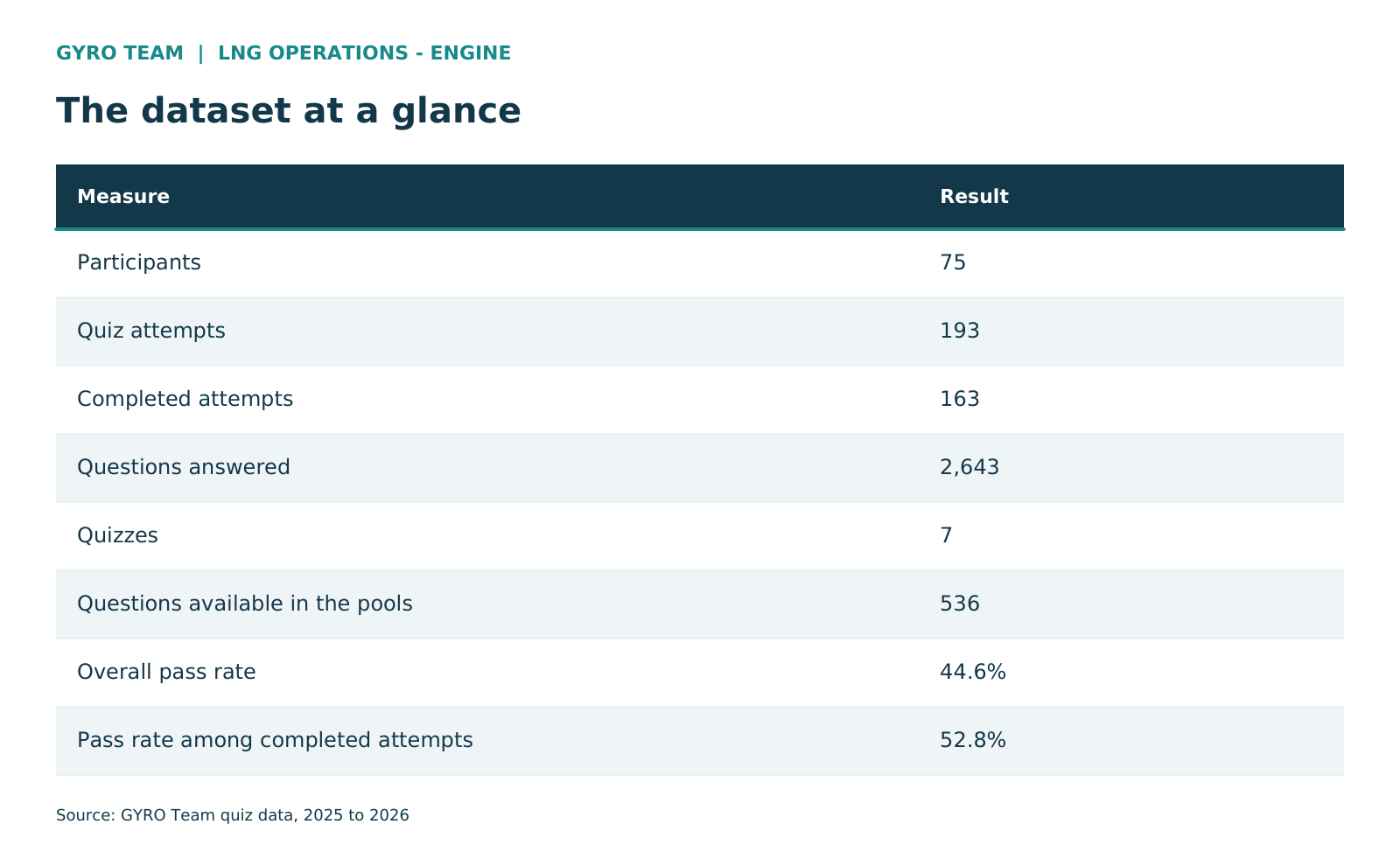
The dataset at a glance
Across the wider GYRO Team platform, LNG Operations sat around the middle of the difficulty ranking. Using non-zero attemptsfor comparison, its pass rate was 51.2%, placing it 11th from the hardest among18 categories with at least 30 attempts. It was considerably harder than thegeneral Engine Department Competence category, which recorded a 75.1% pass rateon the same
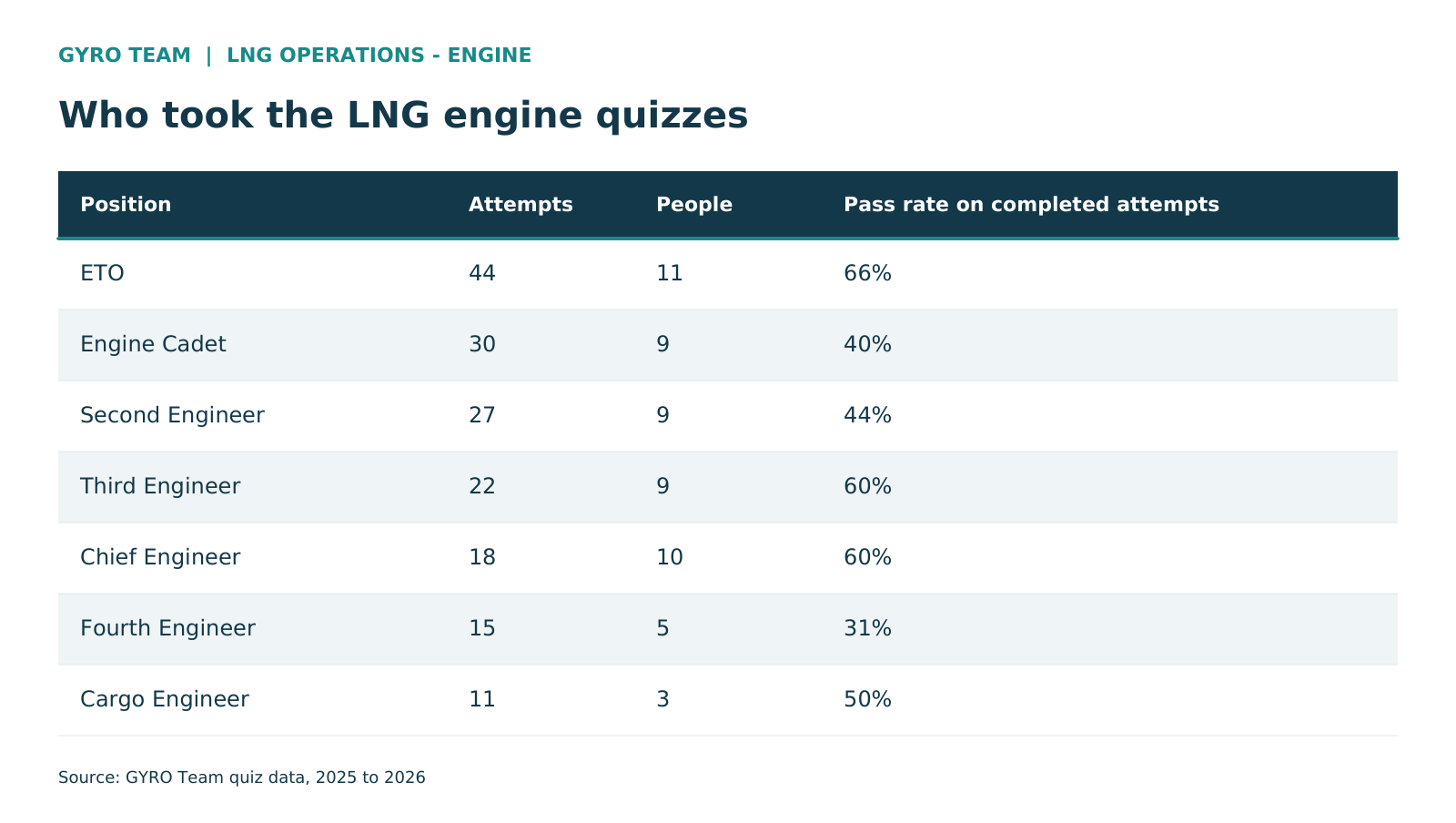
Who took the LNG engine quizzes
The category reached the audience it wasdesigned for. Engine officers, electrical officers, cadets and specialist gasor cargo engineers accounted for almost all participation. The most activeindividual positions were ETO, Engine Cadet, Second Engineer, Third Engineer,Chief Engineer and Fourth Engineer.
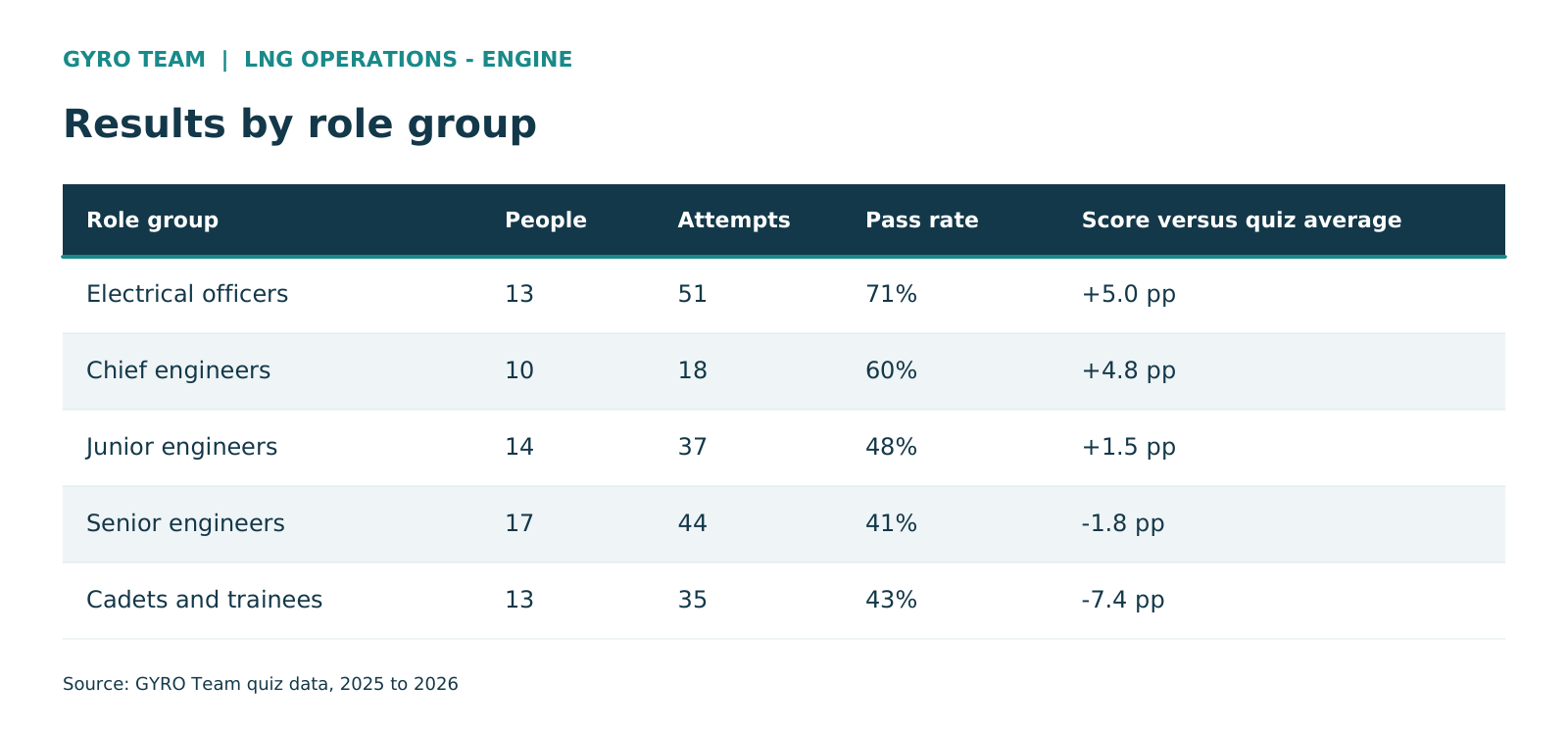
Electrical officers led the results
When related positions were grouped,electrical officers achieved the strongest consistent result. The ETO and ChiefElectrical Engineer group completed 51 attempts, passed 71% of them and scored5.0 percentage points above the average for the same quizzes.
Chief engineers also performed above thequiz average, although the sample was smaller. Senior engineers - includingsecond, first, cargo and gas engineers - passed 41% of completed attempts,below the 48% recorded by junior engineers. In this dataset, rank alone did notpredict the result.
Which quizzes were the most difficult
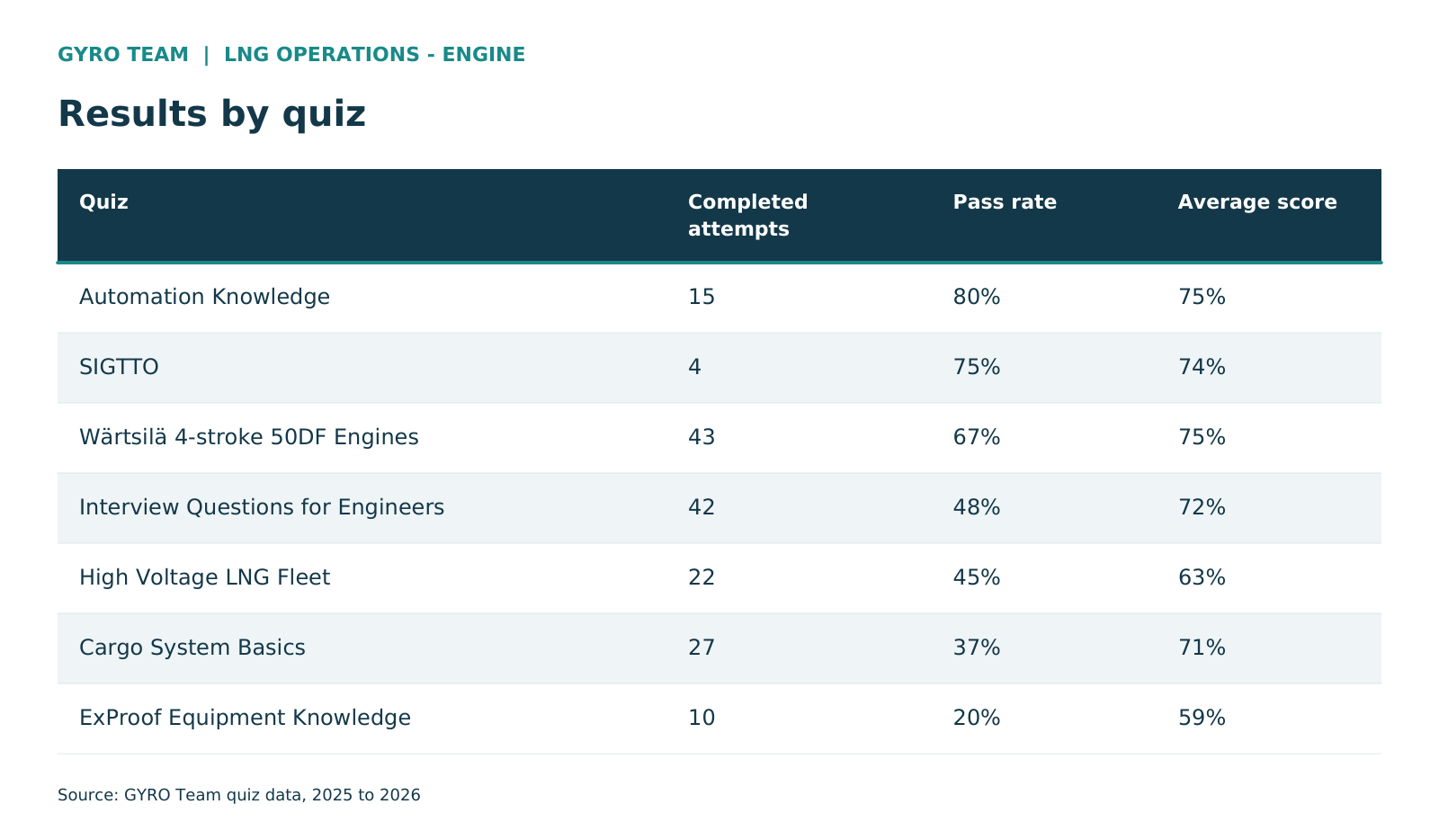
The seven quizzes covered interviewpreparation, dual-fuel engines, cargo systems, high voltage, automation,explosion-protected equipment and SIGTTO-related knowledge. Pass rates variedsubstantially.
ExProof Equipment Knowledge had thelowest pass rate, followed by Cargo System Basics and High Voltage. However,the smallest samples - especially SIGTTO and ExProof - should be treated asdirectional rather than definitive.
Where the largest knowledge gaps appeared
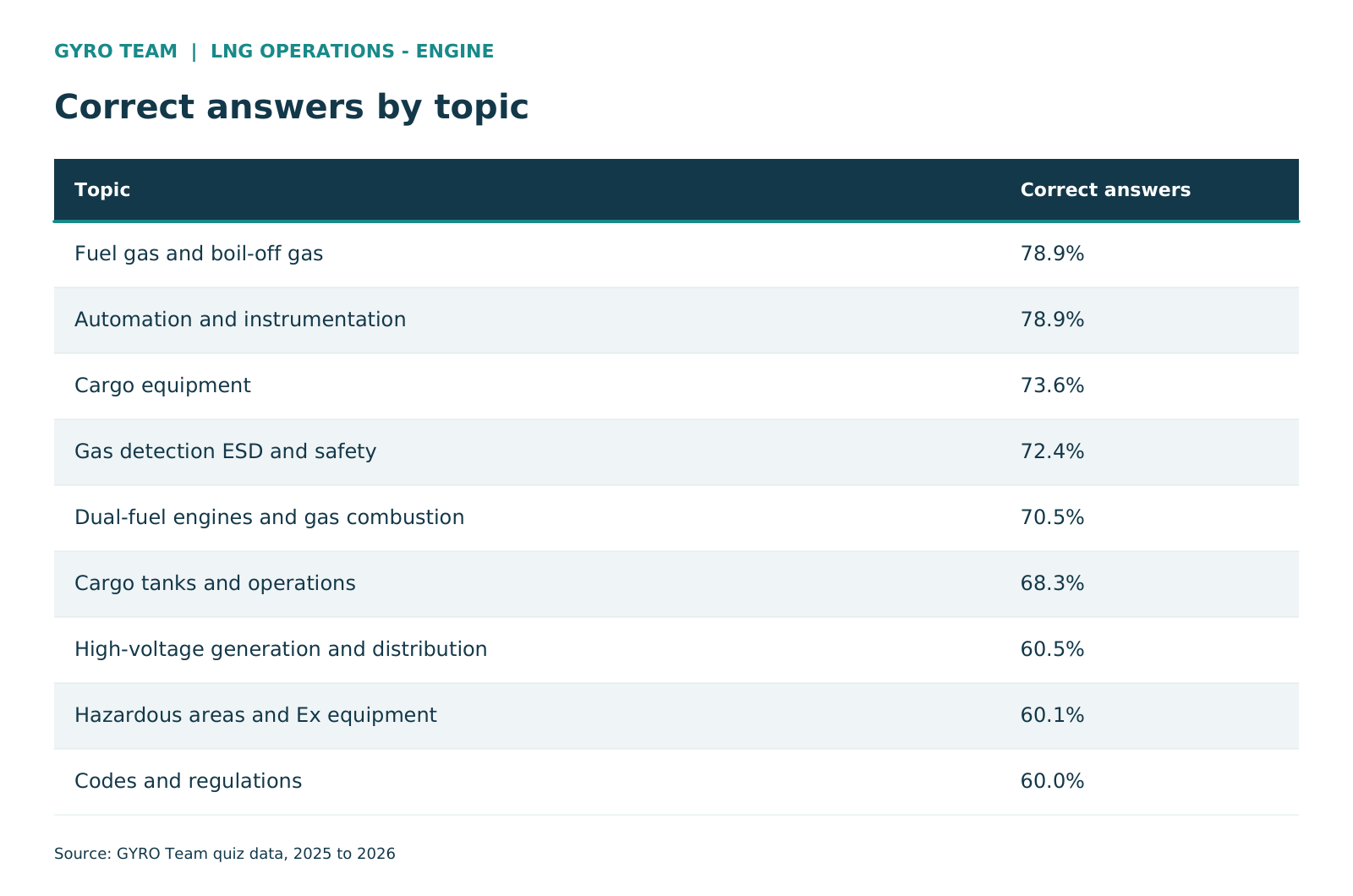
A question-level analysis gives a clearerpicture than quiz pass rates because it separates the subject from the lengthand passing threshold of each test. Fuel gas, boil-off gas, automation andinstrumentation produced the highest accuracy. The weakest results appeared inhigh-voltage generation and distribution, hazardous areas and Ex equipment, andcodes and regulations.
The role-specific results support thesame conclusion. Electrical officers answered automation questions correctly in85% of cases, but their accuracy on high-voltage generation and distributionfell to 66%. Senior engineers recorded 53% on Ex zones and equipment, whilechief engineers recorded 50%. These topics were difficult across several ranks,not only among cadets.
The hardest reliable questions
Low accuracy does not automatically meana question is technically difficult. Before interpreting the results, thelowest-scoring items were reviewed for incorrect keys, ambiguous wording andvessel-specific assumptions. After excluding clearly invalid items, thefollowing questions remained among the most difficult.
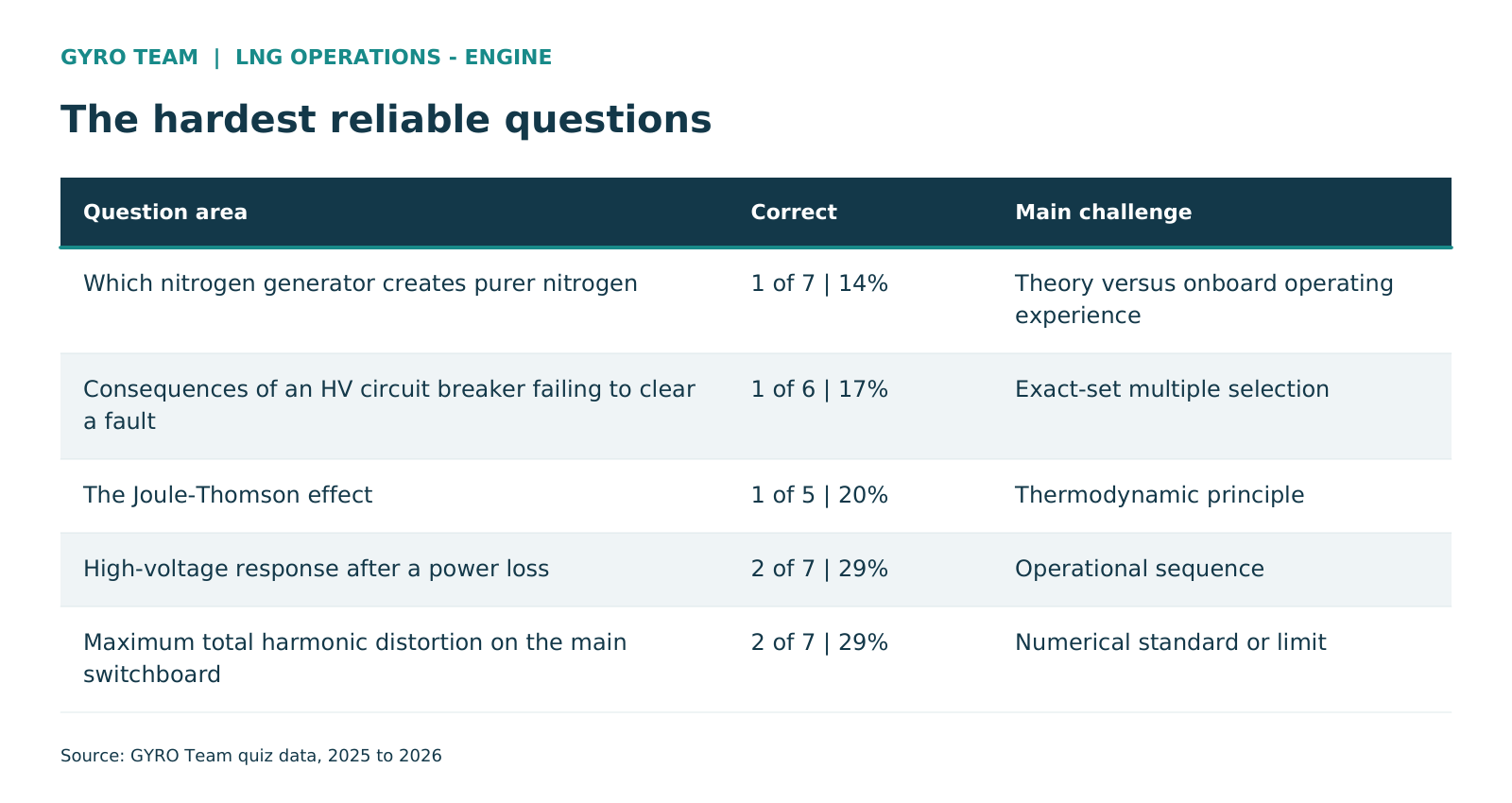
The review also identified threequestions with incorrect answer keys and six with ambiguous or vessel-dependentwording. These items were not used as evidence of a knowledge gap. One exampleasked for the condensation temperature of LNG: 14 of 20 answers selectedapproximately -162 °C, while the stored key was -190 °C. The response patterncorrectly exposed the faulty key.
Three important questionsabout LNG
- At what temperature doesnatural gas become LNG at close to atmospheric pressure?
Thereference temperature is around −162 °C. The exact value depends on the gascomposition and pressure.
- What is the JBOG systemused for?
Jetty Boil-Off Gas recovery captures gasfor reuse that would otherwise be flared during LNG ship loading.
- How is the gas mixtureignited in a Wärtsilä 50DF engine?
In gasmode, the engine operates on the lean-burn Otto principle. A small pilotinjection of diesel fuel ignites the mixture.
Three difficult questions to Cargo System Basics

- Which technology typicallyproduces higher-purity nitrogen - PSA or membrane separation?
PSA - pressure swing adsorption. Itgenerally offers higher purity, although the actual result depends on theequipment and operating conditions.
- How does the volume of afixed amount of ideal gas vary with temperature at constant pressure?
Volume isdirectly proportional to absolute temperature: V/T = constant, with T inkelvin. This is Charles’s law in the English-language test. Gas law names varybetween educational traditions, so we state the conditions explicitly.
- What does theJoule – Thomson effect describe?
The changein a real gas’s temperature when it is throttled to a lower pressure atconstant enthalpy. The gas may cool or heat up, depending on its properties andinitial conditions.
What the results suggest for LNG training
The data points to three practicalpriorities for LNG engineering training:
· Give more attention tohigh-voltage protection, fault response and restoration procedures.
· Strengthen understanding ofhazardous-area classification and the selection and marking of Ex equipment.
· Teach codes, limits and setpoints with their operational context instead of relying on isolated numericalrecall.
The analysis also shows why questionquality matters. Vessel-specific settings need enough context,multiple-selection questions should make the expected number of answers clear,and a low-scoring item should be checked before it is treated as proof thatseafarers lack knowledge.
About the data
These tests were developed with support from our partners, PRO LNG. Offers training for engineers and electrical officers working on LNG and LPG vessels, including LPG/LNG Interview Questions, SIRE/CDI Inspection Observations for Engineers, and individual technical consultations. If you are preparing for an interview or moving into the gas carrier fleet, we recommend exploring their courses and contacting their team.
You can browse the available LNG Operations - Engine practical maritime tests in the GYRO test database.


%201.svg)
Read Similar Articles