



Why collision risk requires more than just checking CPA.
.png)

%201.svg)

Can You Conclude That There Is No Risk of Collision Simply Because the CPA Is Increasing?
At first glance, it may seem logical that if the CPA (Closest Point of Approach) is increasing, the situation is becoming safer. This is why many mariners instinctively answer "Yes."
However, that answer is incorrect.
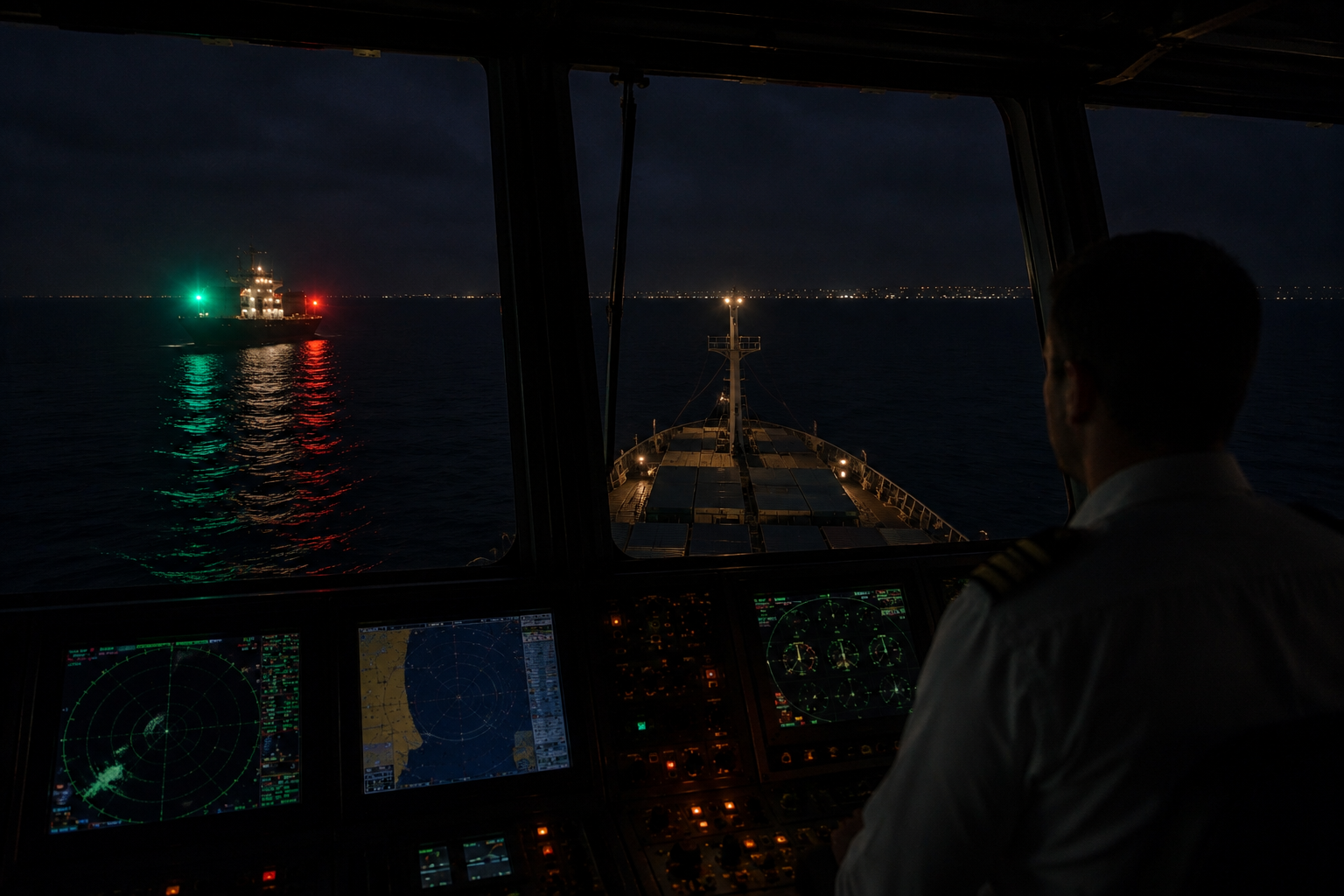
According to Rule 7 - Risk of Collision of the International Regulations for Preventing Collisions at Sea :
"Every vessel shall use all available means appropriate to the prevailing circumstances and conditions to determine if risk of collision exists."
In other words, an Officer of the Watch must never base a collision risk assessment on a single navigational parameter.
Why Doesn't an Increasing CPA Guarantee Safety?
CPA represents only the predicted minimum passing distance between two vessels. Even if the CPA is increasing, the Officer of the Watch must still consider:
- Relative bearing changes;
- TCPA (Time to Closest Point of Approach);
- Courses and speeds of both vessels;
- Radar and ARPA information;
- Visual observations;
- Traffic density;
- Manoeuvrability of the vessels involved;
- Weather and visibility conditions.
Each of these factors can significantly affect the overall collision risk assessment.
One of the Most Important Requirements of Rule 7
Rule 7 also contains one of the fundamental principles of the COLREGs:
"If there is any doubt such risk shall be deemed to exist."
This means that whenever there is any uncertainty, the Officer of the Watch must assume that a risk of collision exists.
For this reason, professional navigators never rely solely on the CPA value when making navigational decisions.
A Practical Example
Imagine that after a slight course alteration, the ARPA indicates that the CPA has increased from 0.3 NM to 1.2 NM.
Does this automatically mean the situation is safe?
Not necessarily.
Before reaching that conclusion, the Officer of the Watch should confirm that:
- the ARPA target is being tracked correctly;
- the CPA trend is stable;
- the target vessel has not altered course or speed;
- no additional traffic is affecting the situation;
- all applicable COLREG requirements are being complied with.
Only after evaluating the complete navigational picture can a reliable assessment of collision risk be made.
Conclusion
CPA is an important navigational parameter, but it must never be used as the sole basis for concluding that there is no risk of collision.
This is exactly what Rule 7 - Risk of Collision requires. Safe navigation depends on a comprehensive assessment of all available navigational information, not on a single figure displayed on the radar or ARPA screen.
Test Your Knowledge
Want to find out how well you understand the International Regulations for Preventing Collisions at Sea (COLREGs)? Test your decision-making skills and improve your confidence on the bridge.
https://app.gyro.team/link/quiz-colreg-collision-avoidance-sce-1785835013


%201.svg)
Read Similar Articles
.png)