


.png)

%201.svg)

What Seafarers Really Say About Their Ships: First GYRO Ship Reviews Data Report
What makes a ship a good place to work? A modern vessel? Good food? Reliable internet? Comfortable accommodation? A professional crew? Supportive shore management? Every seafarer will probably answer this question differently.

But when hundreds of ship reviews from real seafarers are analysed together, individual experiences begin to form a much bigger picture. For the first time, GYRO has analysed the growing data collected through GYRO Ship Reviews to better understand how seafarers rate their vessels, what they value onboard, what they complain about, and perhaps most importantly what makes them willing to recommend a ship to another seafarer.
The results reveal some expected problems, but also several surprising patterns. Internet is one of the most common complaints, but it is not necessarily a deal-breaker.
The age of a vessel appears to matter far more than its flag. Senior officers and junior crew can experience the same working environment very differently. Anonymous reviews tell a noticeably more critical story.And one operational issue stands out above almost everything else: delayed crew change.
Before looking at the numbers, however, there is something more important we want to say.
First of All - Thank You, Seafarers
This report would not exist without you. Every review represents someone who took a few minutes to share their experience of working onboard a vessel. Some of you praised excellent crews and supportive management. Others wrote about poor living conditions, technical problems, delayed relief, workload, internet access or situations that future crew members should know about.
Individual reviews help the next seafarer understand a particular vessel. But when hundreds of reviews are brought together, they can also help us understand broader patterns in seafarer working conditions and life onboard ships.
So before anything else: Thank you to every seafarer who has contributed to GYRO Ship Reviews. These are your experiences. We are simply helping turn them into a bigger picture.
What Does a “Good Ship” Actually Mean?
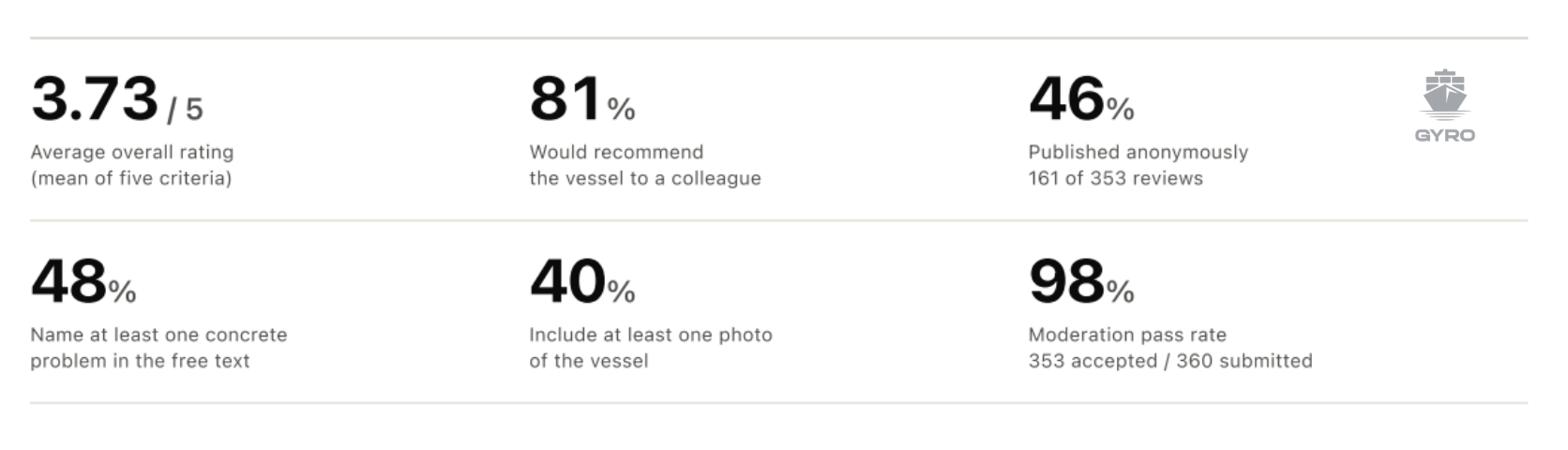
Across the reviews analysed for the first GYRO Ship Reviews Data Report, the average overall vessel rating was 3.73 out of 5, while 81% of reviewers said they would recommend the vessel to another seafarer.
But the overall score tells only part of the story. We asks seafarers to evaluate several aspects of their onboard experience. The highest-rated category was: Teamwork - 3.90 / 5
Followed by:
- Living conditions - 3.78
- Provision - 3.70
- Digital communication - 3.67
- Manager interaction - 3.60
At first glance, the differences do not appear enormous. But things become much more interesting when we compare seafarers who would recommend their vessel with those who would not.
What Actually Determines Whether a Seafarer Recommends a Ship?
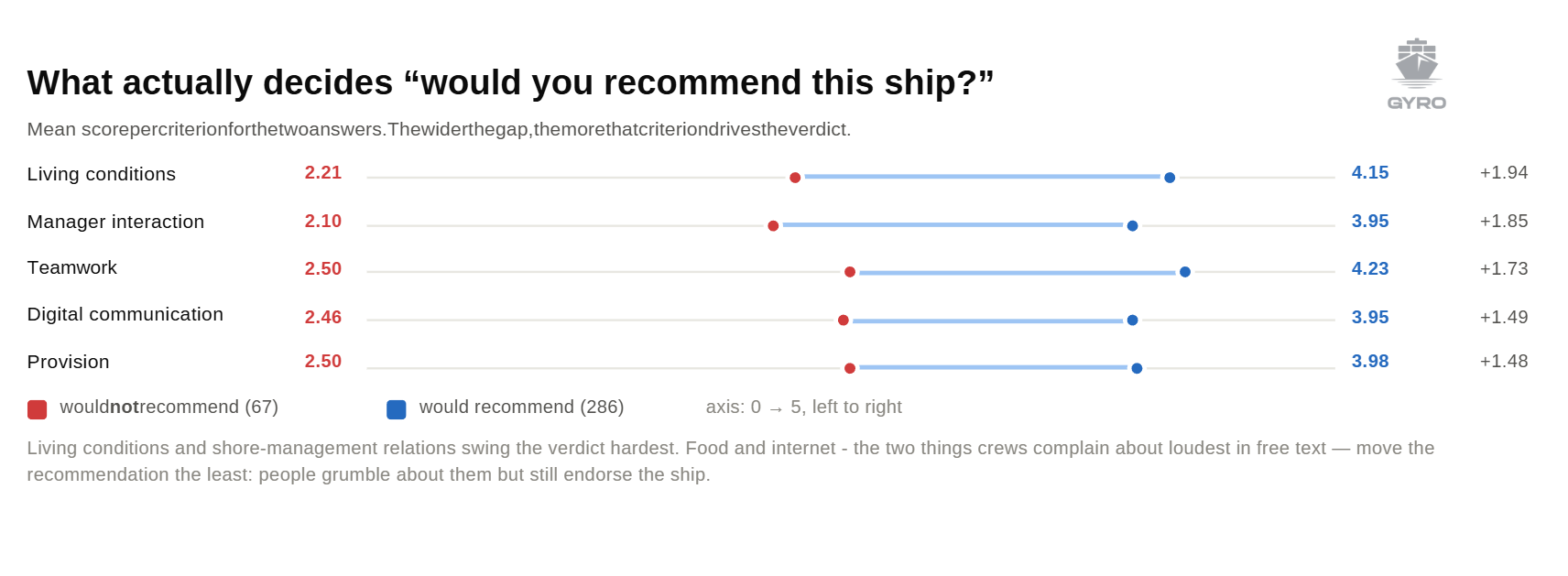
The biggest differences appeared in living conditions, interaction with management and teamwork. Among seafarers who would recommend their vessel, the average living-conditions score was 4.15. Among those who would not, it was just 2.21. Manager interaction showed a similarly large difference: 3.95 among those who would recommend the vessel versus 2.10 among those who would not.
Teamwork also showed a significant gap: 4.23 versus 2.50.
The message is important. A vessel may have modern equipment. It may have good internet. The food may be acceptable. But the human side of working at sea - how people live, work together and interact with management - appears closely connected with whether a seafarer considers a vessel a good place to work.
Seafarers Complain About Internet - But Is It Really the Deal-Breaker?
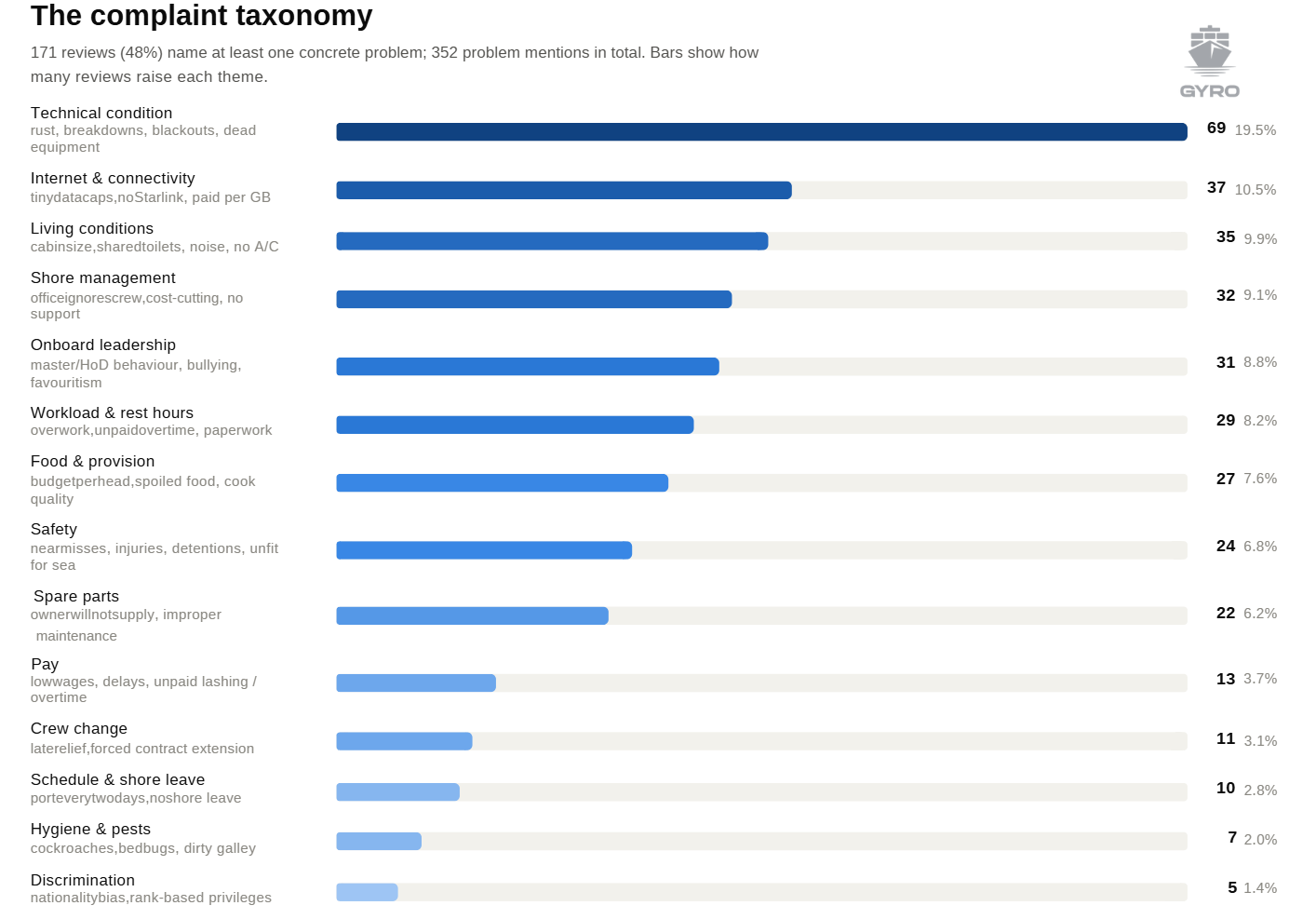
Ask almost any modern seafarer about life onboard and sooner or later the conversation will probably reach internet access.That makes sense. For people spending months away from home, connectivity is not simply entertainment. It is how seafarers speak to partners, children, parents and friends. Internet and connectivity were among the most frequently mentioned problems in written ship reviews. But the data revealed an interesting contradiction. Seafarers complain about internet frequently - yet many still recommend the vessel.
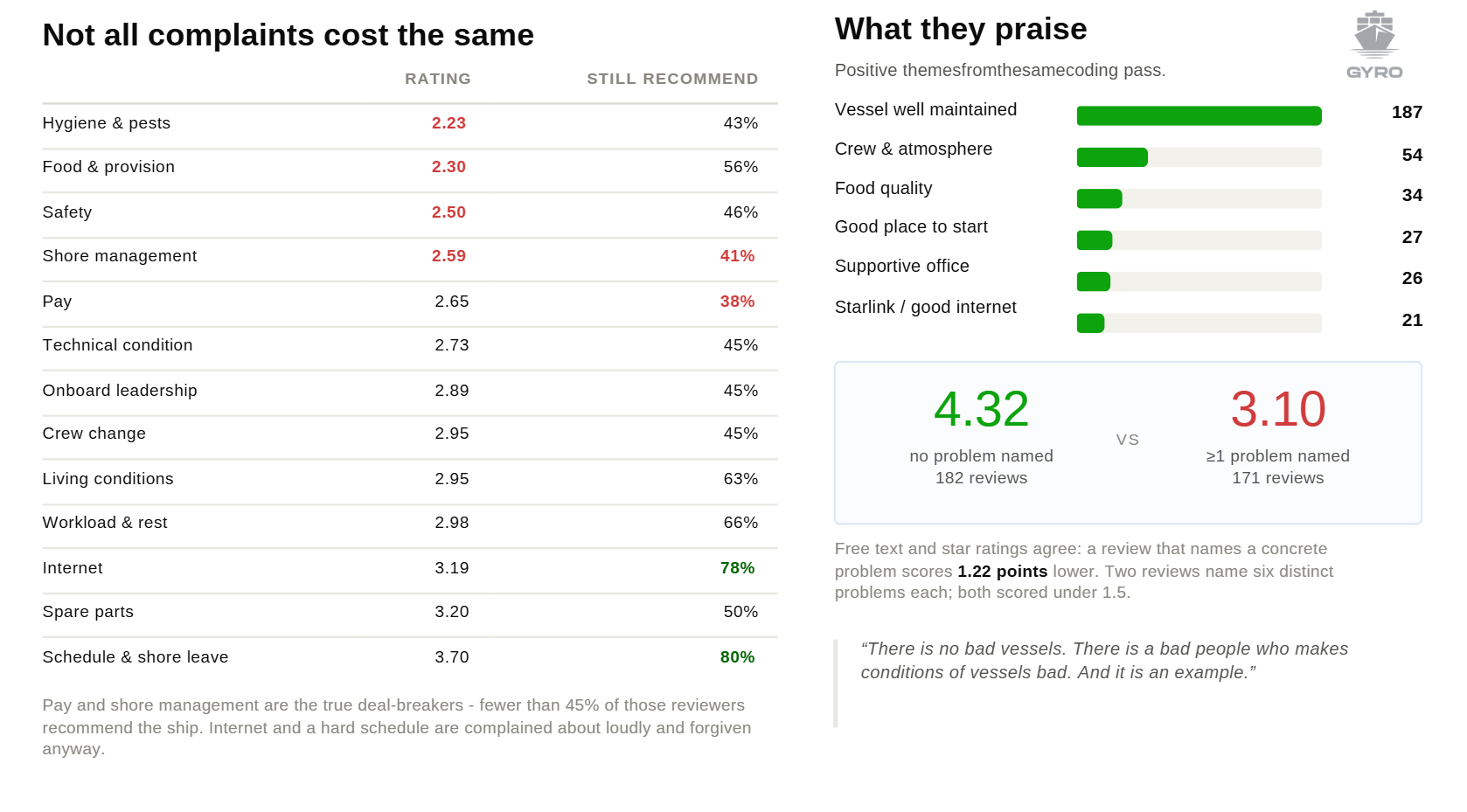
Among reviews mentioning problems with internet or connectivity, 78% of reviewers still said they would recommend the ship. Compare that with other complaints: When shore management was identified as a problem, only 41% would still recommend the vessel. When pay was identified as a problem, the figure was only 38%. This suggests an important distinction: The problems seafarers talk about most are not necessarily the problems that influence their final opinion the most. Poor Wi-Fi is frustrating. But a difficult relationship with management, problems with pay or a feeling that the company does not support its crew can affect the perception of the entire contract.
What Are Seafarers Actually Complaining About?
Written reviews provide something that star ratings alone cannot: context. Across the analysed reviews, 48% of the dataset - mentioned at least one specific problem. In total, the analysis identified 352 problem mentions. Reviews that mentioned at least one concrete problem had an average rating of 3.10. Reviews where no specific problem was mentioned averaged 4.32. That is a difference of 1.22 rating points. But negative experiences are only half the picture. Seafarers also used their reviews to recognise what was working well. Among the positive themes identified were well-maintained vessels, good crew atmosphere, good food, supportive offices, good places for starting a career and reliable internet such as Starlink.
This matters. A ship review system should not exist only to expose problems. It should also allow seafarers to recognise the vessels, crews and companies that are doing things well.
The Same Ship Can Be a Different Workplace Depending on Your Rank
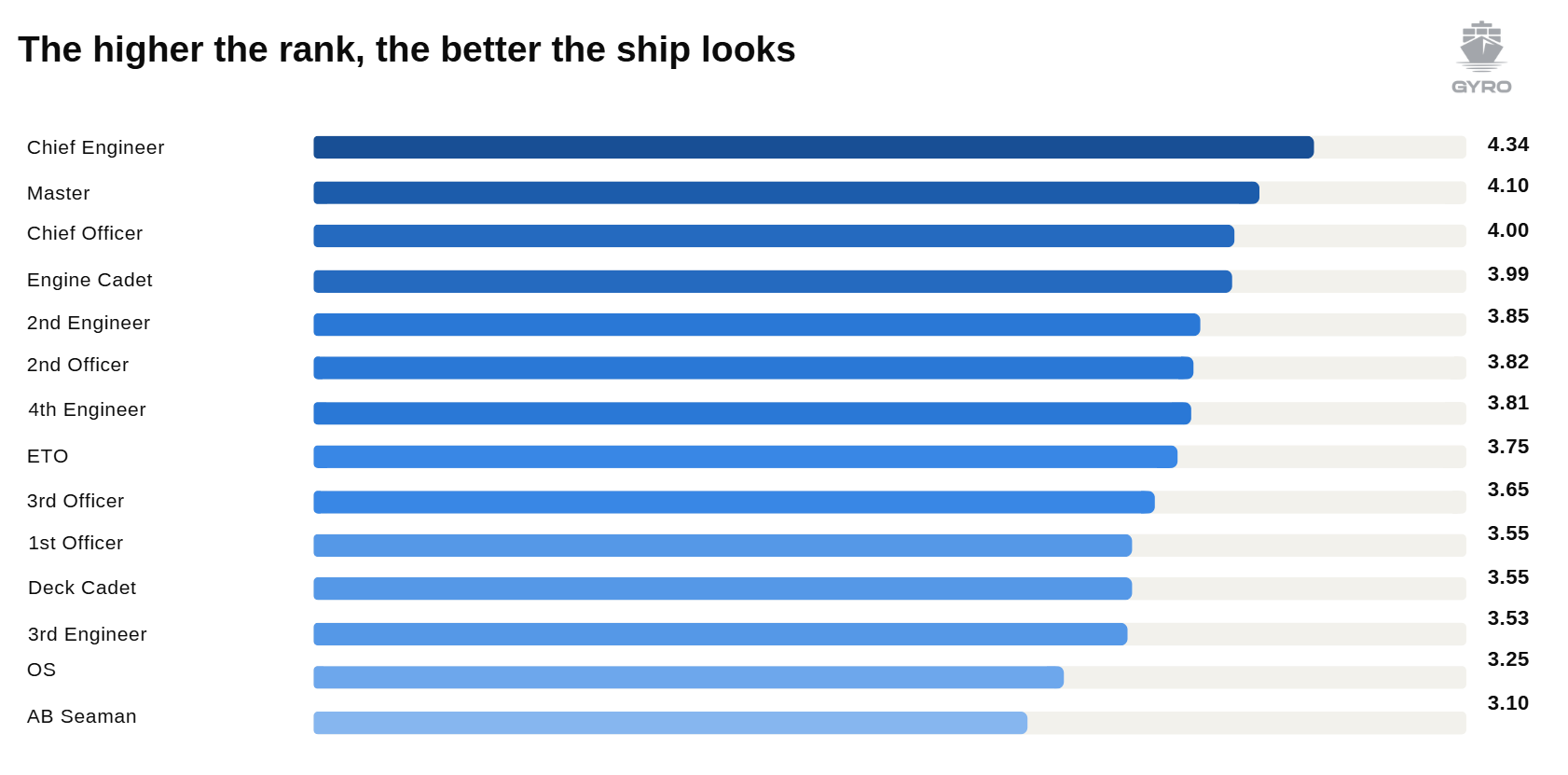
One of the most interesting findings appeared when ship ratings were compared by rank. The pattern was clear: Senior officers generally rated their vessels higher than junior officers, cadets and ratings.
Grouped average ratings were:
- Senior officers - 3.98
- Junior officers - 3.75
- Cadets & trainees - 3.53
- Ratings & crew - 3.49
This does not tell us why the difference exists. And it certainly does not mean that one group is “right” while another is “wrong.” Instead, it raises an important question about life at sea.
Can Two People Work on the Same Ship but Experience Two Different Workplaces?
Their cabin may be different.Their workload may be different. Their relationship with management may be different. Their responsibilities, privileges, access to information and ability to influence decisions may also be different. Even crew change appears different depending on rank. Senior officers reported late crew changes approximately three times less often than junior officers - 4.7% compared with 13.4%.
The ship is the same. But the experience may not be. For an industry increasingly focused on crew welfare, retention, leadership and working conditions at sea, this difference deserves attention.
Deck and Engine Departments See the Ship Differently Too
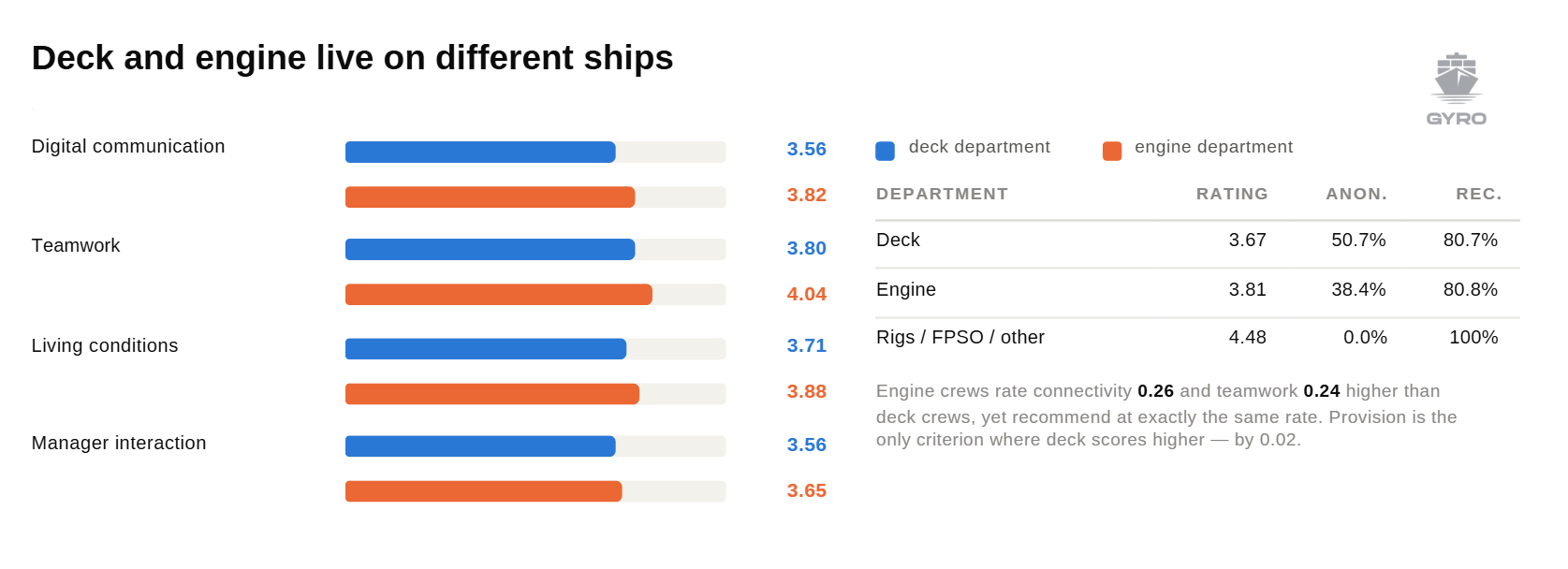
Rank was not the only difference. Deck and engine departments also showed slightly different perceptions of their vessels. The average rating among deck department reviewers was 3.67, compared with 3.81 among engine department reviewers. Engine crews rated digital communication 0.26 points higher and teamwork 0.24 points higher than deck crews. Interestingly, however, the final recommendation rate was almost identical: 80.7% for deck and 80.8% for engine. Different departments may perceive individual aspects of life onboard differently, while still arriving at almost exactly the same final answer to the question: Would you recommend this vessel?
Anonymous Ship Reviews Tell a Different Story
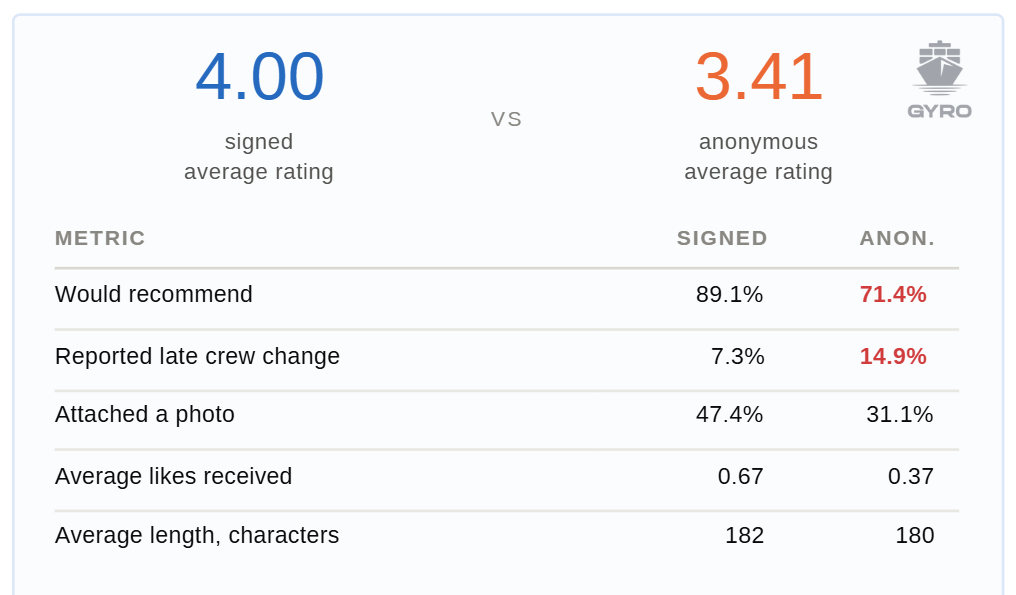
GYRO allows seafarers to share ship reviews anonymously.The first dataset gives us an interesting indication of why this option matters. Signed reviews had an average rating of: 4.00 / 5 Anonymous reviews averaged: 3.41 / 5
Recommendation rates also differed. Among signed reviews, 89.1% would recommend the vessel. Among anonymous reviews, that number fell to 71.4%.
It would be easy to assume that anonymous reviews are simply quicker or lower-effort complaints. But the data does not support that assumption. The average signed review contained 182 characters. The average anonymous review contained 180.
Almost identical. Anonymous reviewers were not writing less. They were simply reporting more negative experiences. For seafarers, this matters. Ships are unusual workplaces. People do not simply work together, they often live together for months, sometimes thousands of miles from home. Hierarchy is strong, careers depend heavily on reputation, and speaking openly about a negative experience may not always feel easy.
Does the Age of a Ship Matter?
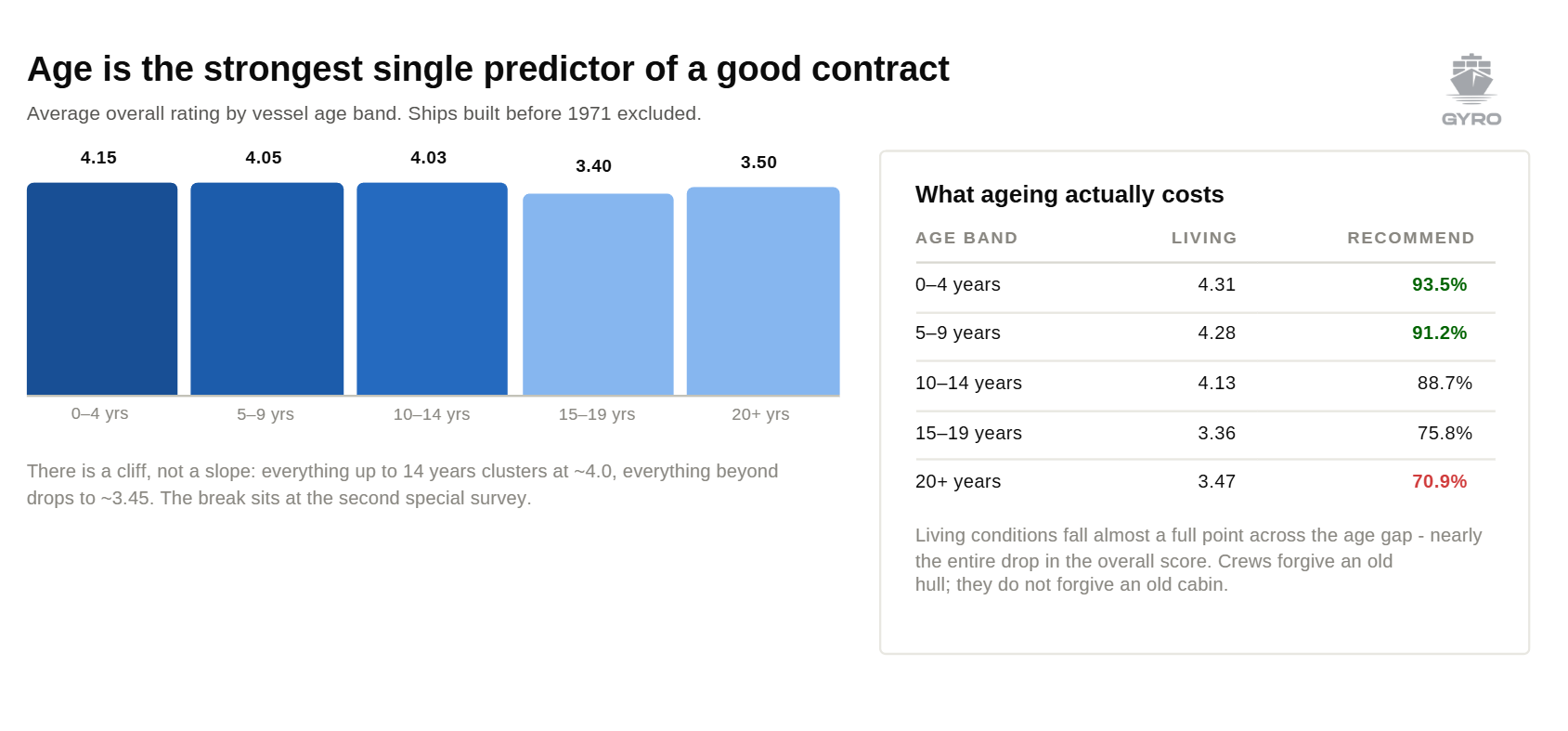
Yes - and the difference is surprisingly clear. Average ratings by vessel age were:
- 0–4 years - 4.15
- 5–9 years - 4.05
- 10–14 years - 4.03
- 15–19 years - 3.40
- 20+ years - 3.50
Up to around 14 years of age, vessel ratings remained relatively stable at approximately 4 out of 5. After that, the ratings dropped sharply. But the most interesting part is where that deterioration appears. Living conditions showed one of the strongest changes. In other words: Seafarers may forgive an old hull. They are less likely to forgive an old cabin. Ageing accommodation, living spaces and other aspects of everyday life onboard appear to play an important role in how older vessels are perceived.
What About the Flag?
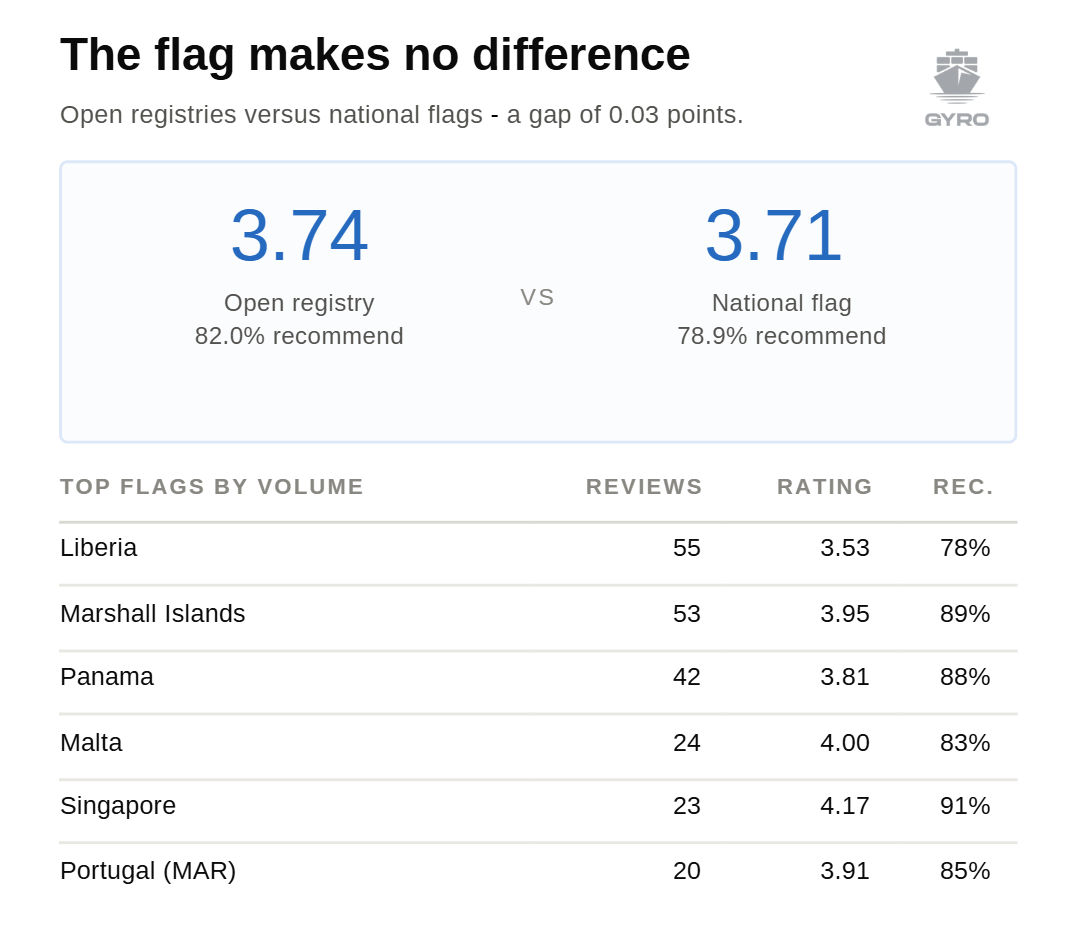
Flag is one of the first things many seafarers notice when looking at a vessel. But in this dataset, the difference between open registries and national flags was remarkably small. Open-registry vessels averaged: 3.74 / 5 National-flag vessels averaged: 3.71 / 5 A difference of only 0.03 points. Recommendation rates were also relatively close: 82.0% for open registries and 78.9% for national flags. At least within this dataset, vessel age appears considerably more informative about the onboard experience than whether the vessel operates under an open registry or a national flag. That does not mean flag never matters. It means that the reviews collected so far do not show a meaningful rating difference based on this factor alone.
Bigger Ships, Better Living Conditions?
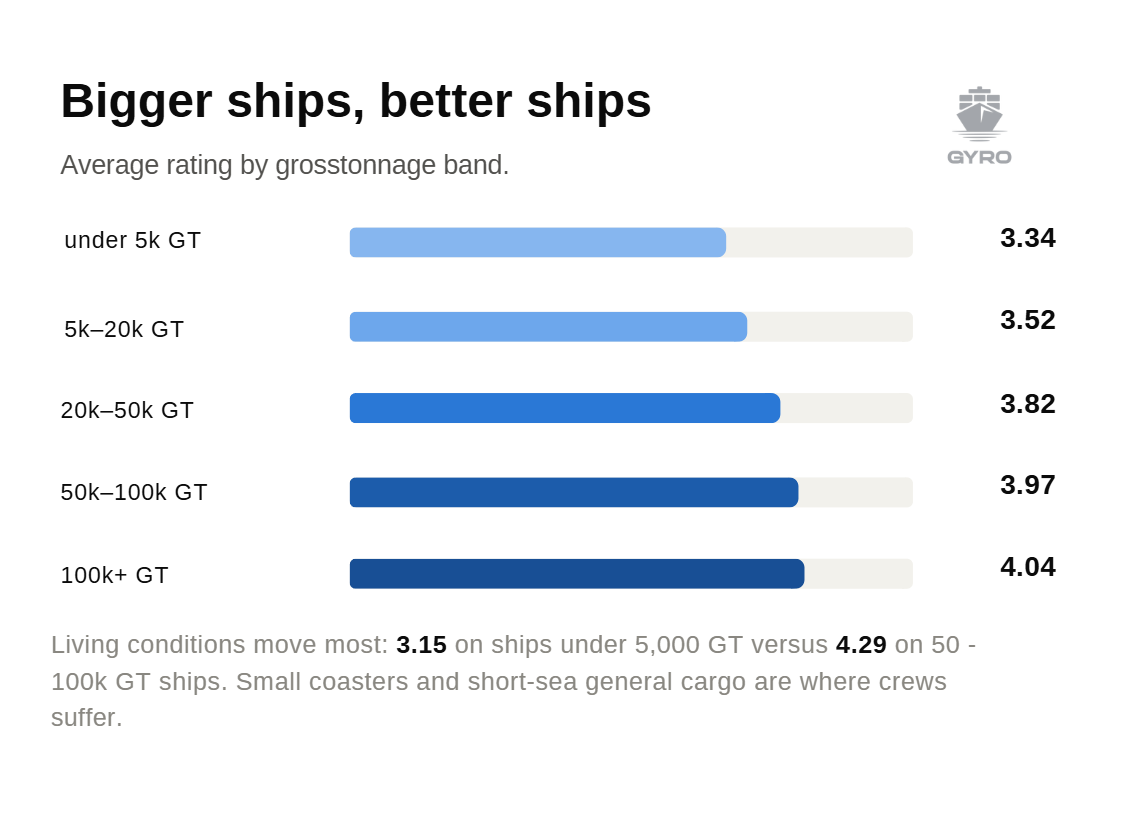
Vessel size produced another interesting pattern. Average overall ratings increased from 3.34 for vessels below 5,000 GT to 4.04 for vessels between 50,000 and 100,000 GT. But again, the most noticeable difference appeared in living conditions. Living conditions averaged only 3.15 on vessels below 5,000 GT. On vessels between 50,000 and 100,000 GT, the average reached 4.29. The report suggests that smaller coasters and short-sea general cargo vessels are among the areas where crew living conditions deserve particular attention.
The Finding We Cannot Ignore: Delayed Crew Change
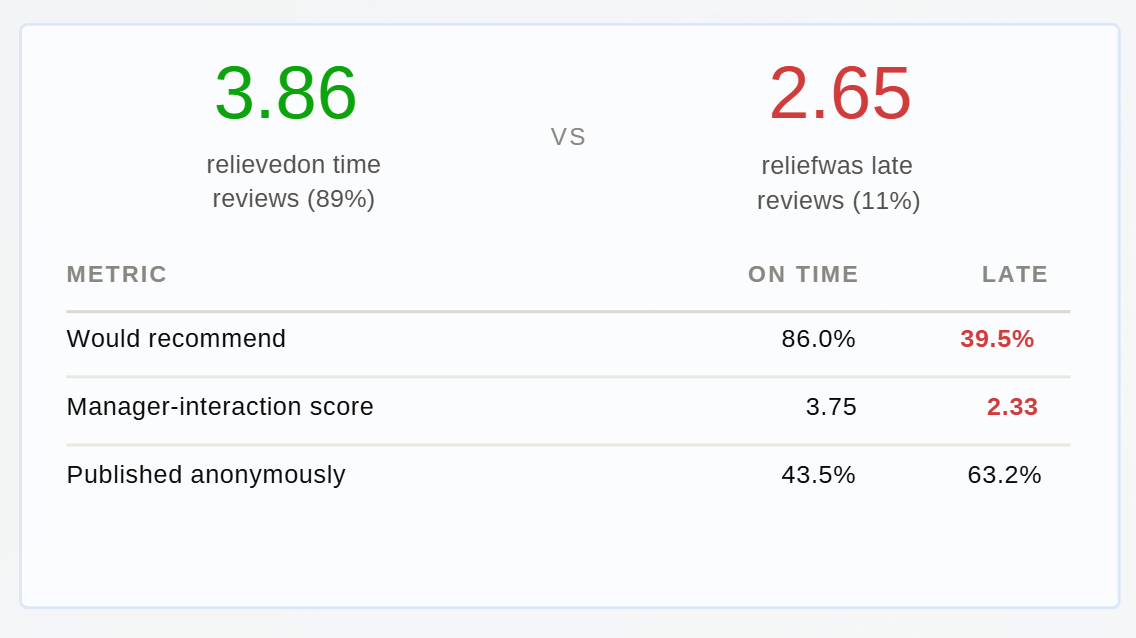
Of all the patterns identified in the first GYRO Ship Reviews analysis, one stands out. Crew change. For seafarers who were relieved on time, the average ship rating was: 3.86 / 5. For those whose relief was delayed: 2.65 / 5. That is a difference of 1.21 rating points.But the recommendation rate shows the impact even more clearly.
When crew change happened on time: 86% would recommend the vessel.
When relief was late: Only 39.5% would recommend it.
The rating for interaction with shore management also dropped dramatically: 3.75 → 2.33 And anonymous publishing became more common among those who experienced delayed relief. The conclusion is difficult to ignore. A delayed crew change does more than extend someone's contract. It can change how a seafarer sees the vessel, the management and the entire experience onboard. A seafarer may forgive an older vessel. They may tolerate imperfect internet. They may complain about food and still sign another contract. But when the promised date for returning home stops meaning anything, the issue becomes something more fundamental.
It becomes a question of trust.
Why Ship Reviews Matter
A single ship review is one person's experience. It cannot tell the complete story of a vessel, company or crew. But when more seafarers share their experiences, patterns begin to emerge. That is the idea behind GYRO Ship Reviews. Not to create a blacklist. Not to label every vessel as simply “good” or “bad.” But to give seafarers access to information that has traditionally been difficult to find before signing a contract. What are the living conditions like? How is the atmosphere onboard? How does management interact with the crew? Is the vessel well maintained? Was crew change carried out on time? Would someone who actually worked there recommend the vessel to another seafarer? These are questions that job descriptions and vessel specifications rarely answer. Other seafarers can.
Your Experience Can Help the Next Seafarer
The first GYRO Ship Reviews Data Report is only a snapshot. As more reviews are submitted, the picture will continue to evolve. More vessels will be represented. More nationalities, departments and ranks will contribute. Patterns may become stronger. Some may change. And entirely new ones may appear. That is why every genuine review matters. If you worked on a good vessel, say so. Recognise the crew. Recognise good leadership. Recognise a company that treated people properly. And if your experience was difficult, sharing it can help another seafarer understand what questions to ask before accepting the same contract. You can choose to publish your review under your profile or anonymously.
To everyone who has already shared a ship review through GYRO: thank you.
You helped create the data behind this report. More importantly, you helped another seafarer. And if you have not shared your experience yet, perhaps yours can be the next piece of the picture.
Share Your Ship Experience → LEAVE A SHIP REVIEW
See What Other Seafarers Say → EXPLORE SHIP REVIEWS
Building a More Transparent Maritime Industry - One Review at a Time
The maritime industry depends on information. We collect data about vessel performance, machinery, fuel consumption, navigation, cargo operations and safety. But information about what it is actually like to live and work onboard a particular ship has historically been much harder for seafarers to access. Ship reviews cannot solve every problem in the industry. But they can make one part of it more transparent. And perhaps the most important lesson from our first analysis is also the simplest: A good ship is defined not only by what is installed onboard. It is defined by how people live there, how they work together, and how they are treated. Keep sharing your experiences. We will keep listening.
Train • Sail • Grow
This article is based on the first GYRO Ship Reviews Data Report. The analysis uses reviews submitted by seafarers through GYRO Ship Reviews. Individual reviews represent the experiences and opinions of their authors. Findings presented here describe patterns within the collected dataset and should not be interpreted as universal conclusions about all vessels, flags, companies or sectors of the maritime industry.
Source: GYRO Team — Ship Reviews Data Report, 2026.


%201.svg)
Read Similar Articles