


First insights from GYRO maritime knowledge quizzes
.png)

%201.svg)

First of All, Thank You for Taking Part
Every attempt behind this report came from someone who opened a quiz and decided to test their knowledge.
Thank you to everyone who took part. Your participation helps us understand how people use maritime knowledge tests and where our learning content may need more explanation, clearer questions or closer review. These are early findings from a voluntary learning platform. They describe this group of participants and their recorded attempts; they are not a verdict on the competence of the maritime workforce.
What Does a 38.7% Pass Rate Actually Tell Us?
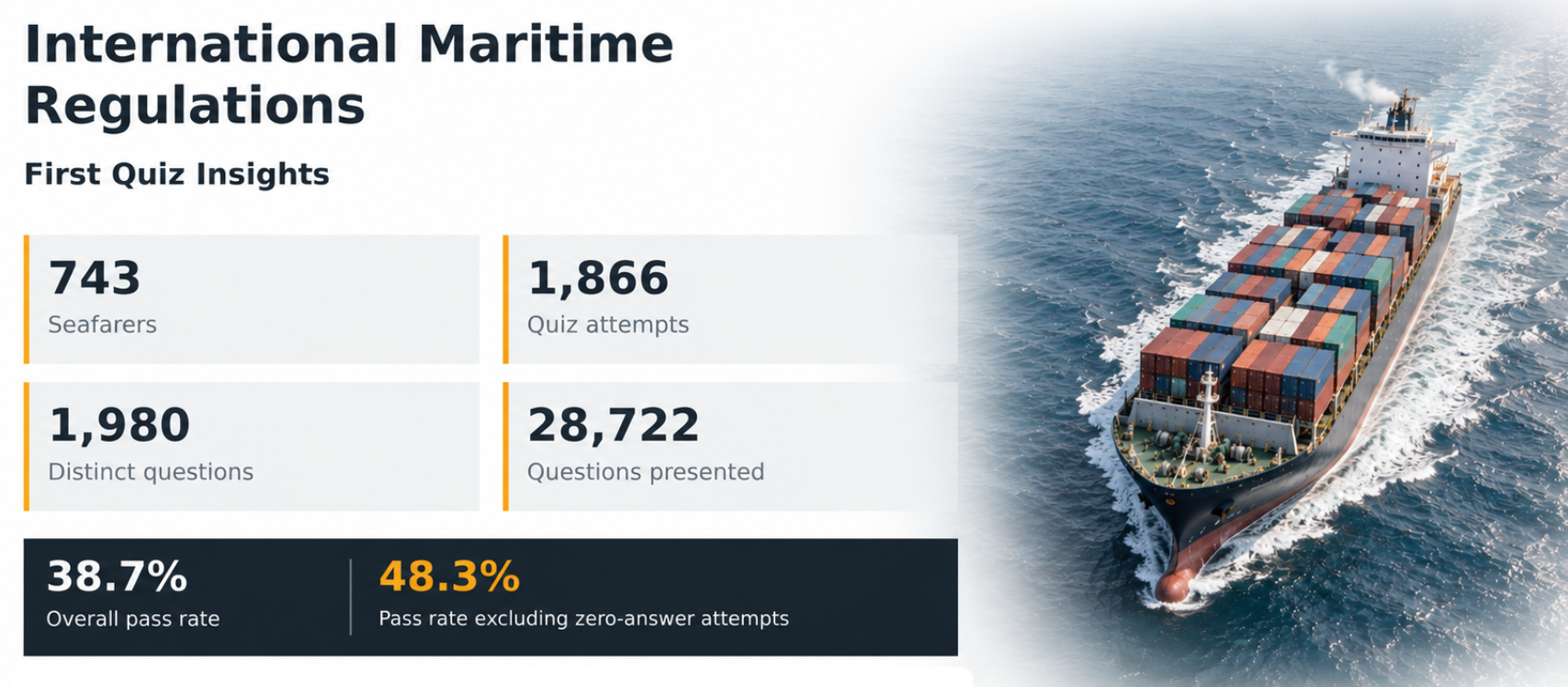
Across the dataset, the overall pass rate was 38.7%. When attempts with no answers recorded were excluded, it rose to 48.3%. That difference matters. An attempt with no recorded answers tells us little about what a participant knows. We cannot determine from this report why those attempts ended without answers.
We also need to distinguish two measures used throughout the analysis:
- Correct-answer rate describes the proportion of answers marked correct within the questions or attempts included in that calculation.
- Pass rate describes the proportion of quiz attempts that met the test's passing requirements.
Quiz lengths and pass thresholds vary between tests. A topic can therefore have a relatively high correct-answer rate while showing a much lower pass rate. The two figures answer different questions.
COLREG Leads the Recorded Results, While SOLAS Attracts the Most Attempts
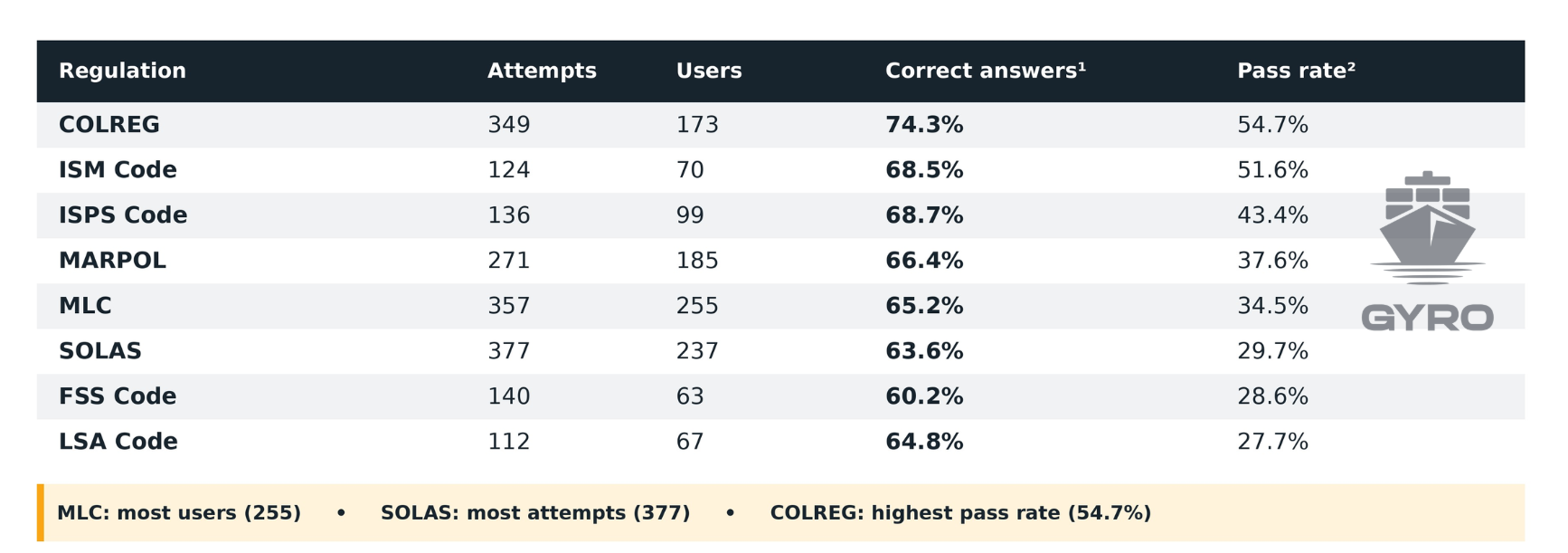
Among the eight topics, COLREG recorded the highest correct-answer rate at 74.3%, alongside the highest pass rate at 54.7%. The ISM Code and ISPS Code recorded correct-answer rates of 68.5% and 68.7%, respectively. SOLAS recorded 63.6%, while the FSS Code recorded 60.2%. Participation tells another part of the story. SOLAS attracted the most attempts, with 377, while MLC reached the most users, with 255. The subject people return to most often is not necessarily the one with the highest recorded results.
Does a Higher Rank Always Mean a Higher Quiz Score?
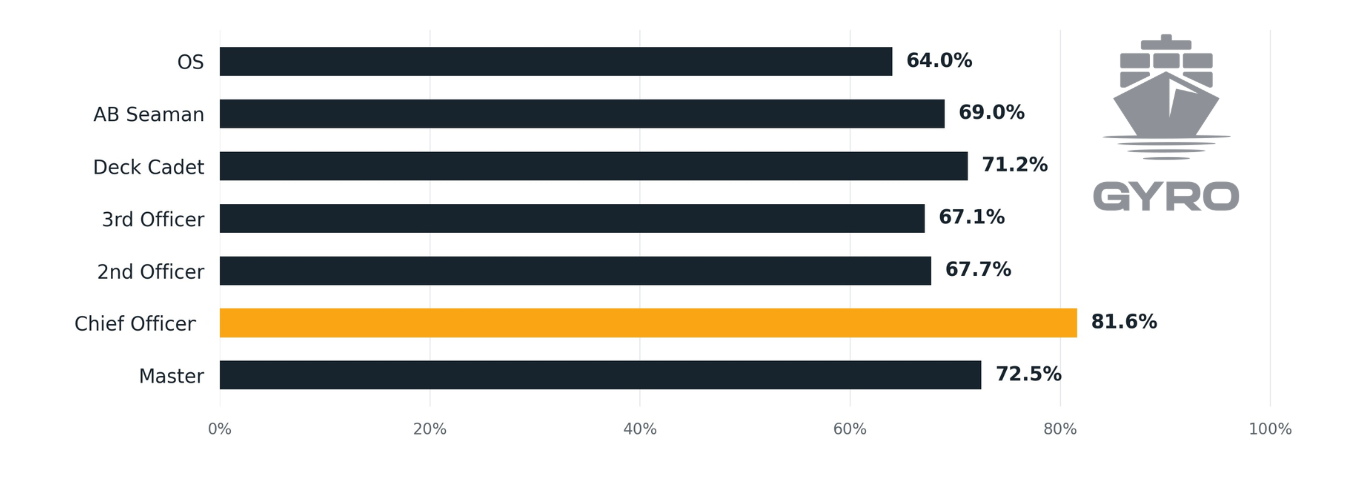
The deck department results did not follow a simple progression from junior to senior rank. Chief Officers recorded 81.6% correct answers, the highest figure among the deck ranks shown. Masters recorded 72.5%, and Deck Cadets 71.2%. Third Officers and Second Officers recorded 67.1% and 67.7%, respectively.
Deck and Engine Officers Choose Different Topics
The way participants distribute their study attempts is revealing in its own right. Among deck officers, SOLAS accounted for 25.4% of attempts, followed by COLREG at 20.2%. Among engine officers, MARPOL accounted for 28.5%, followed by MLC at 23.0% and SOLAS at 20.0%. These percentages describe the share of attempts within each officer group. They are not scores or percentages of officers studying a subject.
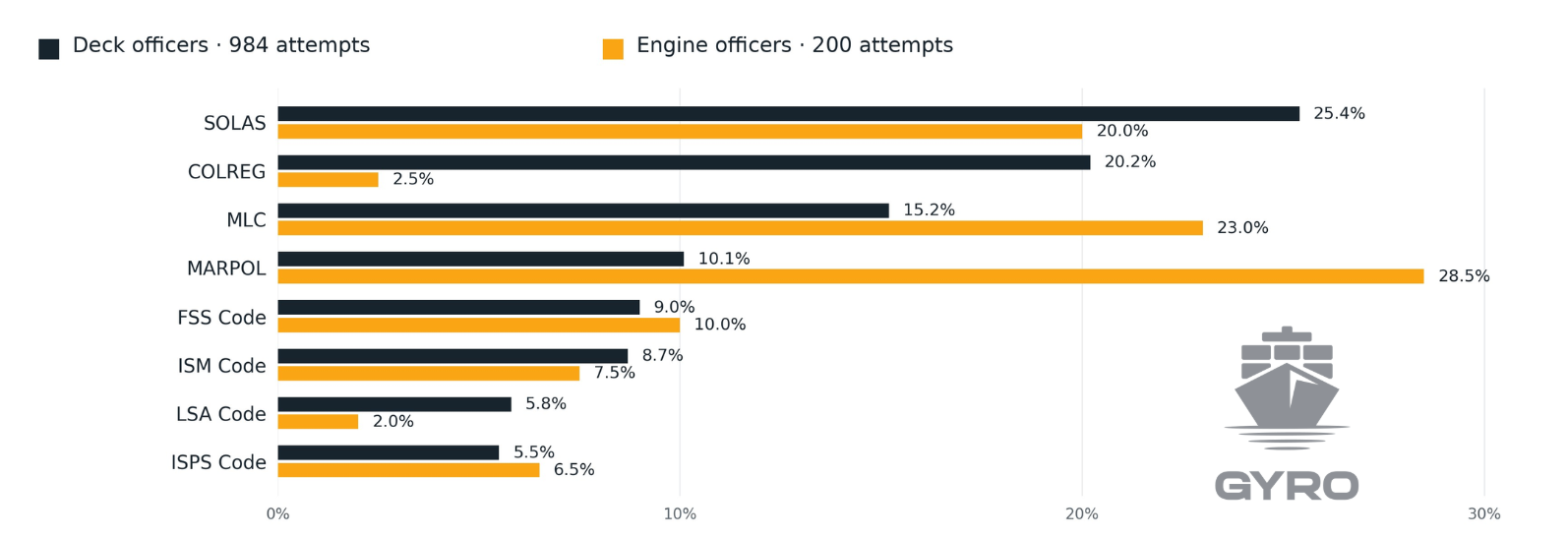
The pattern is consistent with different professional interests, although the data does not tell us each participant's motivation. It gives educators a useful question to explore: how can learning materials connect familiar work topics with subjects that receive less attention?
An Overall Score Can Hide Topic Differences
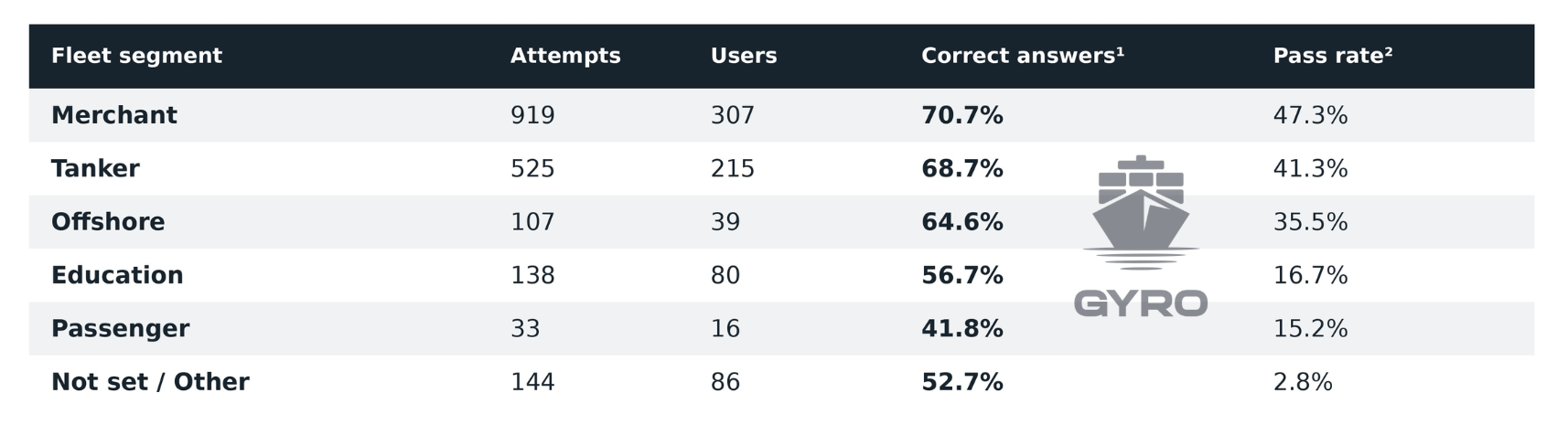
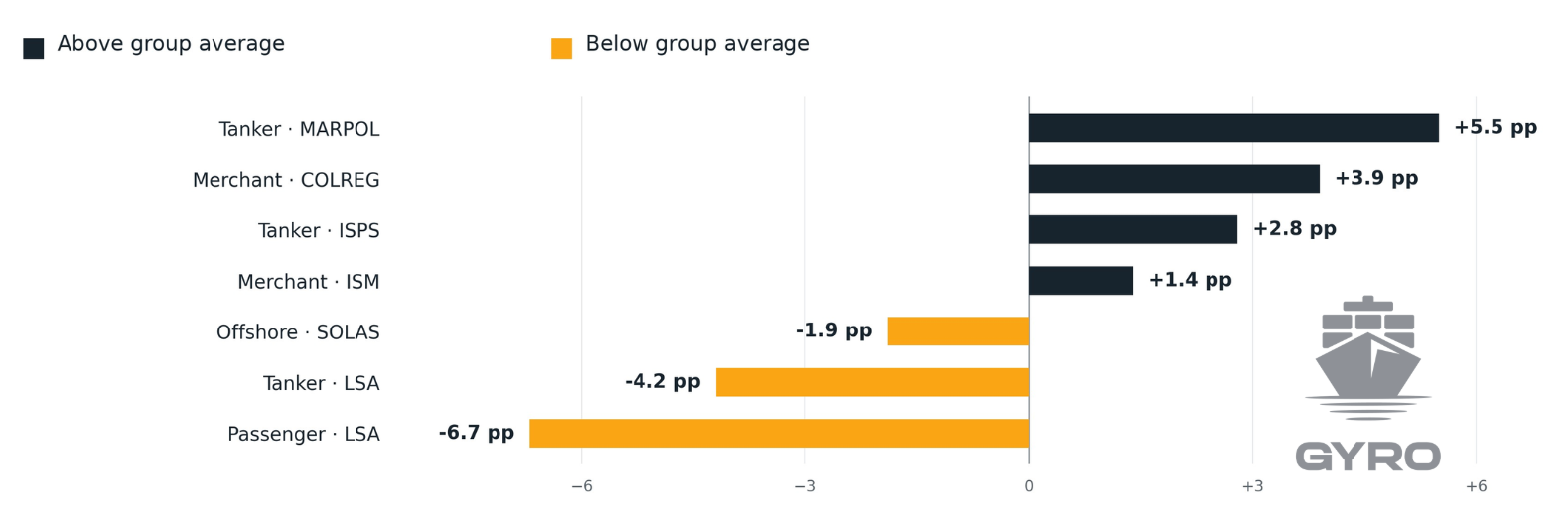
The fleet analysis adds another perspective. In the report's Merchant and Tanker groups, correct-answer rates on fully answered tests were 70.7% and 68.7%, respectively. More interesting than the overall comparison is how individual topics sit against each group's own average. The Tanker group scored 5.5 percentage points above its own average on MARPOL, but 4.2 points below it on LSA. The Merchant group scored 3.9 points above its own average on COLREG.
A Difficult Question Is Also a Question Worth Reviewing
The report highlights several individual questions with low recorded scores. A MARPOL Annex II question recorded 8.8% correct in a sample of 34. A question about davit classification recorded 23.0% in a sample of 61. Even COLREG, the strongest topic overall, contained a question about overtaking in restricted visibility that recorded 45% correct in a sample of 20.
What Can You Take From These Findings?
For seafarers, the most useful outcome is a more focused approach to revision. Try a topic, identify the answers you were unsure about and return to the relevant learning material. When a question seems ambiguous, check the reference and raise it for review.
For educators and content creators, aggregated results can help identify where explanations may need improvement and which questions deserve closer scrutiny. Further analysis would be needed to determine whether repeat practice leads to better results over time; this first snapshot does not measure that effect.
We want GYRO's knowledge tests to support that process: giving seafarers a reason to revisit a subject, check an assumption and keep learning.
Which Maritime Quiz Questions Proved Most Challenging?
An overall quiz score can hide the specific details that participants find difficult. Our first analysis highlighted several questions with low recorded correct-answer rates across different maritime topics.
MARPOL Annex II - identifying Special Areas
A question asking which areas are classified as Special Areas under MARPOL Annex II recorded just 8.8% correct answers in a sample of 34. Among the four examples highlighted in the report, this had the lowest recorded score.
SOLAS - identifying davit types
A question asking which type of davit is not considered a mechanical davit recorded 23.0% correct answers in a sample of 61. It draws attention to a specific equipment-classification detail that may deserve further explanation in learning materials.
COLREG - overtaking in restricted visibility
A true-or-false question about whether overtaking rules still apply in restricted visibility recorded 45% correct answers in a sample of 20. Even though COLREG had the strongest overall results, this particular question proved challenging for the participants represented here.
LSA Code - lifebuoy fire resistance
A question about how long a lifebuoy must withstand fire without sustaining burning recorded 54% correct answers in a sample of 24. It highlights how precise equipment requirements can be harder to recall than the general purpose of the equipment.
For seafarers, these results offer a useful starting point for revision. For those creating maritime learning content, they identify questions that deserve closer attention and clearer explanations.
Which topic would you choose to revisit first?
Explore the maritime knowledge tests on GYRO and take a closer look at your own results.
Train. Sail. Grow.
Source: GYRO Team, Maritime Knowledge: First Insights, 2026. Findings describe the analysed platform sample, not all seafarers. Topic and deck-rank correct-answer rates concern answered questions; fleet-segment accuracy uses only fully answered attempts. Pass rates include all attempts unless explicitly stated otherwise. Users may appear in multiple topics, and attempts are not unique participants. Quiz results are not a substitute for formal assessment or demonstrated competence onboard.


%201.svg)
Read Similar Articles